

Why Consider Technology ETFs in Canada?
Investing in a technology focused ETF gives you exposure to some of the fastest-growing sectors globally such as semiconductors, cloud, AI, software, data centers, and more without having to pick individual stocks. For Canadian investors, tech ETFs also help:
- Avoid currency-conversion (Norbert Gambit) hassles when choosing CAD-listed ETFs.
- Reduce individual stock risk while capturing growth of many companies at once.
- Keep diversification across firms, sub-sectors and geographies.
- Simplify portfolio construction, a great approach for all portfolios.
That said, tech ETFs carry their own trade-offs such as higher volatility, concentration in a few mega-cap firms, currency risk, and often higher fees than broad-market funds.
In this article, I cover the best technology ETFs in Canada. If you’d like to know how my story started and what my plans are, you can find my monthly financial reports here.
Related: Detailed analysis of XAW and VXC versus holding underlying funds directly on Best & Most Tax Efficient US & International ETFs Listed on TSX. XAW vs VXC and beyond!
Technology ETFs Quick Notes and Trade-offs
- Concentration risk: ETFs like QQQT are heavily weighted toward a few mega-cap firms. Good if you believe in their long-term dominance but risky if broad tech underperforms.
- Currency risk vs hedging: CAD-hedged ETFs (QCC.F, XQQ) reduce your exposure to USD/CAD swings while unhedged or foreign ETFs still carry currency risk.
- Tax & reporting implications: Canadian-listed ETFs are generally exempt from foreign-property filing requirements (Form T1135), while US listed ETFs may trigger reporting if held outside registered accounts.
- Volatility: Technology — especially thematic or narrow-focus ETFs — tends to have higher volatility. Good for long-term growth, but requires patience and long horizons.
- Fees: With recent fee reductions, some ETFs have become more cost-effective.
Best Tech ETFs: Updated List for Today’s Market
Let’s explore the top technology ETFs in Canada. This review concentrates on broad, benchmark-oriented funds and does not cover niche or thematic technology ETFs.
TEC – TD Global Technology Leaders Index ETF
TEC is a technology ETF offered by TD Bank which seeks to track the Solactive Global Technology Leaders Index (CA NTR), an index which tracks the performance of technology securities of global mid and large capitalization.
- Geography: 89% US, 5.2 Europe, 3.4 Japan, 0.9% Canada
- Fees: 0.39%
- Distribution Yield: 0.46%
- Total Holdings: 233
In addition to technology, CA NTR also includes companies that belong to other subsectors but are engaged in technology-related themes such as Artificial Intelligence (AI), Cyber Security, Internet of Things (IoT), E-Commerce, Robotics, Automation, Autonomous Vehicles, Cloud, and Big Data.
TEC holds 233 companies, with the top 10 positions representing approximately 65% of the fund’s total weight. Geographic exposure is heavily US focused at around 89%, followed by 5.2% in Europe, 3.4% in Japan, and roughly 0.9% in Canada, including a 0.54% allocation to Shopify.
| Holding Name | Holdings % |
| Nvidia | 12.26 |
| Apple | 11.37 |
| Microsoft | 10.25 |
| Amazon.com | 6.17 |
| Broadcom | 5.34 |
| Alphabet | 9.79 |
| Meta | 4.03 |
| Tesla | 3.66 |
| Visa | 1.58 |
| Mastercard | 1.23 |
The current distribution yield is 0.46% which covers the 0.39% MER. This ETF is not managed actively. However, it gets reviewed once a year to be adjusted including adding or removing companies.
XIT seeks Canadian Information Technology companies which means there is no magnificent seven in this ETF.
- Geography: Canada
- Fees: 0.60%
- Distribution Yield: 0.0%
- Total Holdings: 22
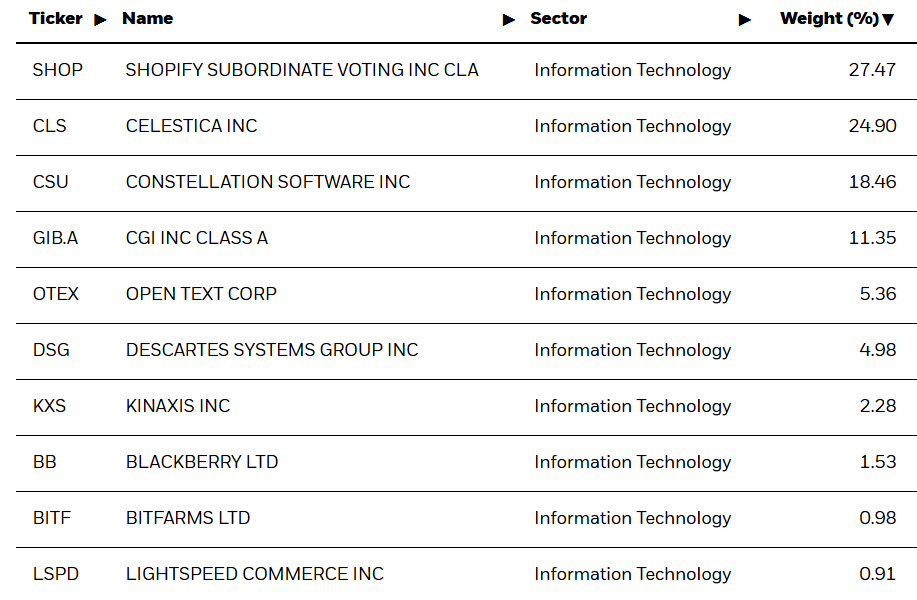
The ETF holds only 22 Canadian Capped IT stocks with a small portion of cash in CAD and USD. Its MER fee is high considering its small and simple holdings.
Below are the top 10 holdings. Interestingly the top 4 count for 82% of the ETF’s total weight.
QQC – Invesco NASDAQ 100 Index ETF
QQC seeks to replicate the performance of the NASDAQ 100 by holding QQQM ETF including the 100 (103 to be exact) largest non-financial companies listed on Nasdaq.
- Geography: US
- Fees: 0.21%
- Distribution Yield: 0.3%
- Total Holdings: 103
Similar to other technology ETFs, this fund doesn’t pay a noticeable distribution yield. However, as of today, the yield covers the MER fees.
QQC’s top 10 holdings count for ~ 53% of the total fund’s weight. Considering its 65% technology holdings, it is fair to consider it as a technology ETF.
A worthy mention is HXQ which is another NASDAQ 100 ETF with 28% MER. This ETF has an efficient structure with no distributions (swap-based) which makes it useful for holding in non-registered account, reducing events, and avoiding dividend tax complexities.
XQQ exposures to 101 of the largest non-financial companies listed on Nasdaq. XQQ’s MER is 0.39% with a 0.23% distribution yield.
- Geography: US
- Fees: 0.39%
- Distribution Yield: 0.23%
- Total Holdings: 101
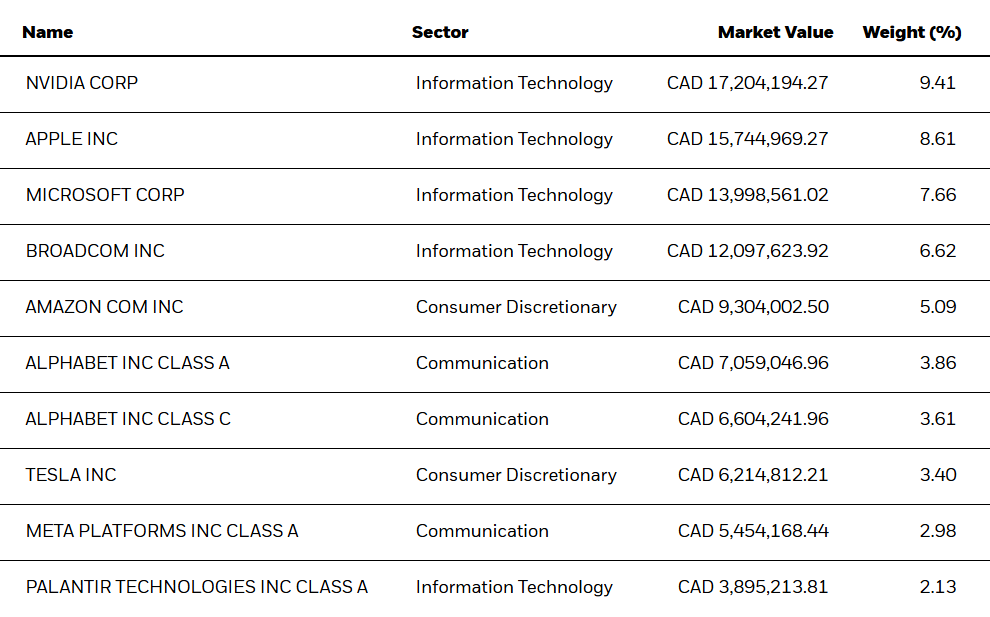
As shown, XQQ is almost the CAD-Hedged version of QQC as it is almost identical in holding and sector allocation.
IYW is the US version of XIT with a huge exposure difference where it holds 140 US Stocks (Versus XIT’s 22 Canadian stocks). IYW is traded on NYSE and is in USD.
- Geography: US
- Fees: 0.38%
- Distribution Yield: 0.14%
- Total Holdings: 140
IYW has a 0.14% trailing yield and a 0.38% MER. The ETF’s top 3 holdings, Nvidia, Apple, and Microsoft count for ~ 45% of its total weight.
Owning a US listed ETF in $USD holding US stocks directly is the best way to avoid the 15% withholding tax in RRSP but it comes with the disadvantage of converting funds from $CAD to $USD.
Growth and Performance Comparison of the Best Tech ETFs
We will now compare the perfroamnce of these tech ETFs. If we compare the 10 year growth, we have to eliminate TEC and QQC due to the lack of enough historical data, newer ETFs.
| Ticker | Geograpical | 1y Growth | 3y Growth | 5y Growth | 10y Growth |
|---|---|---|---|---|---|
| TEC | Global | 23.07 | 33.55 | 18.22 | NA |
| XIT | Canada | 17.91 | 33.27 | 14.27 | 20.44 |
| QQC | US | 21.49 | 30.06 | 16.46 | NA |
| XQQ | US | 19.85 | 27.08 | 14.78 | 17.71 |
| IVY | US | 29.38 | 39.20 | 21.50 | 23.78 |
However, going with the 5 year growth comparison, IVY which is in USD leads the way, followed by the Global TEC ETF tracking global technology companies. QQC which is NASDAQ 100 in Canadian dollar but unhedged comes ahead of the CAD-Hedged NASDAQ 100 XQQ ETF.
And unfortunately, XIT, Canadian technology ETF is at the floor in this comparison.
Which ETF Should You Hold: XQQ vs QQC?
Both XQQ and QQC provide concentrated exposure to the NASDAQ and are nearly identical in their underlying holdings. The primary distinction between them is currency treatment, which results in performance differences over time due to USD–CAD exchange-rate movements.
Their targeted exposure to US technology leaders is compelling but comes with inherent concentration risk. Since both ETFs hold virtually the same US companies, there is no strong analytical basis to recommend one over the other; the choice ultimately depends on your currency preference.
3 ETFs to Compare, TEC vs XIT vs IVY
As demonstrated, XIT’s small Canadian exposure comes with an unjustified MER. Hence, it is better to either hold the broader Canadian market XIC or hold individual technology stocks to save the fees.
With Wealthsimple, Questrade, or Qtrade you buy stocks and ETFs with no commission.
Comparing TEC and IVY is a little unfair as one has global tech exposure while the other is concentrated on US technology companies. On the other hand, TEC is in Canadian dollar while IVY is listed on NYSE in USD. I personally only buy equities in Canadian dollar listed on TSX.
Hence, I personally chooe TEC as it is aligned with my requirement:
- Listed on TSX in Canadian dollar
- Broaded global technology exposure
- Comparable 5 year performance
- Similar MER fee to the other technology ETFs
For transparency, I hold TEC ETF and believe in its long-term continous growth.
Final Thoughts and Picking the Best Technology ETF in Canada
Technology exposure remains essential for any growth-oriented investment strategy, and Canadian investors have several strong ETF options to build that exposure efficiently.
While I continue to purchase the only individual Canadian technology stocks, Shopify, for the domestic portion of my portfolio, US focused technology exposure fits more appropriately within broader SP500 ETFs such as XUU. This approach allows for diversification without the complication of managing multiple foreign currencies or purchasing individual US stocks.
Among the dedicated technology ETFs reviewed – TEC, XQQ, QQC, IVY, and XIT – the choice ultimately comes down to structure, currency preference, and how each ETF fits into your broader asset allocation. TEC offers global tech diversification but introduces foreign-market considerations. XIT remains a straightforward way to access Canadian technology companies, though its narrower universe limits global growth potential. IVY provides well-rounded US exposure but with the currency conversion complication.
When deciding between the NASDAQ-focused ETFs, XQQ and QQC, the core difference is currency treatment rather than holdings. Both provide concentrated access to the world’s leading US technology companies, but the CAD-hedged exposure of XQQ simplifies currency risk management.
For investors prioritizing clarity, simplicity, long-term return potential through the broad US technology exposure within a Canadian-listed structure, XQQ or QQC stand out as practical and efficient choices.
Considering all factors including global diversification needs, tax implications, currency exposure, and alignment with a long-term growth strategy, TEC remains the most compelling technology ETF for Canadian investors.
Its structure provides seamless access to leading global innovators, and integrates cleanly alongside the more focused US ETFs such as XQQ, QQC, and IVY.
Related: Best & Most Tax Efficient US and International ETFs.
Frequently Asked Questions (FAQs)
What is a “technology ETF”?
A technology ETF is an exchange-traded fund whose holdings are primarily companies in technology-related sectors: software, hardware, semiconductors, cloud computing, internet, AI, etc. For Canadians, tech ETFs offer diversified exposure to high-growth industries, often globally, without needing to pick individual companies.
Should I buy a Canadian-listed ETF or a US/international one?
- Canadian-listed: Avoid currency conversion, simplify tax reporting (no foreign-property reporting form), may be CAD-hedged.
- US/International: Broader or narrower exposures (emerging-market tech, Asia, sector-specific), more growth potential but also currency risk and possibly more tax complexity.
Many investors use a mix: Canadian-listed core + one or two foreign/thematic ETFs for diversification.
What are the main risks with tech ETFs?
- Volatility: Tech stocks are cyclical and sensitive to macro factors (rates, regulation, innovation cycles).
- Concentration risk: Some ETFs overweight a few large firms (top 10 holdings might represent 40–70%).
- Currency risk: Unhedged foreign-market ETFs may suffer from unfavorable exchange-rate shifts.
- Tax/Withholding implications: US/foreign dividends may be subject to withholding; structure (swap-based vs distributing) affects tax treatment.
Which ETF are the current best technology ETFs?
It depends on your goals:
- For NASDAQ 100 US exposure → XQQ (hedged) or QQC (unhedged)
- For global diversification including the US → TEC
- For exposure to non-US tech growth (e.g. Asian markets) → CHQQ
- For local Canadian tech → XIT
- For broaded US tech US-listed in USD → IVY
Do I need to use a registered account (TFSA / RRSP) for ETFs?
If you invest in US-listed or foreign ETFs, registered accounts like TFSA or RRSP can help mitigate withholding taxes and avoid foreign-property reporting. Canadian-listed ETFs make reporting easier but may still hold foreign securities underneath. Always check how your broker and tax laws treat each ETF.
How often should I review / rebalance my portfolio with tech ETFs?
Given tech sector volatility, a long-term horizon (5–10+ years) usually smooths out swings. That said, review annually (or after major market shifts) to rebalance allocation, especially if a single theme (e.g. AI, semiconductors) has experienced dramatic growth or decline.
What technology stocks and ETFs do you personally hold?
For Canadian companies, I hold Shopify $SHOP. For US companies, I hold all of them through iShares Core S&P US Total Market Index ETF $XUU. And for a more focused global technology exposure including the magnificent 7 US companies, I hold $TEC.
Where can I buy these ETFs or stocks commission-free?
With Wealthsimple, Questrade, or Qtrade you buy stocks and ETFs with no commission.
Nice post, Mr. Dreamer! I’m not the biggest fan of currency conversion either. The holdings in these ETFs look excellent. I like iShares for ETFs even though I don’t hold any. I also like to look through ETFs and mutual funds to find equities to hold. Thanks for sharing!
Hello Graham & Thank you for stopping by!
I totally agree. I actually keep an eye on ETFs and their holdings to see what big banks value the most and take a risk on. I currently keep adding TEC but have XIT on my radar as they give me a better view on Canada and World’s technology companies.
Happy Investing 🙂
Excellent article ! 👌😃 I bought few months ago, XIT, I thought it was a good idea and after all, I totally agree with you, why pay 0,61% of MER!? So expensive ! Yesterday, I sold my XIT with 8% profit and decided to purchase 2 canadians tech stocks, $LSPD (51 shares) + $OTEX (66 shares), that’s it ! I think for the long run much better ! I see you bought some too, that’s very good !
Congratulations on your 8% profit. I also bought LSPD but sold it when it reached $79. Almost 14% profit. I am not sure if LSPD will function in the upcoming years and I rather take risk with Shopify than LSPD. OTEX is nice too.
What do you think of ZINT ?
Great question. It looks to be similar to others but with a different weighting. The MER isn’t too high at 0.45%.
However, looking at its 1 year performance, you can clearly see that the more customized these ETFs get, the more complicated it becomes to win against the benchmark/boarder market index.
Awesome article! I was thinking about purchasing QQC (non-hedged version) as I feel it would best reflect the performance of its U.S. based QQQ. Knowing that it is relatively new and has low trading volume, do you still recommend buying this ETF if I plan on holding it for 30yrs and contribute to it on a weekly basis. Or will the low trading volume make it very difficult to sell all my accumulated shares 30yrs down the road? Would love to hear your thoughts. Thanks!
Hello Nathan,
Thanks for your kind words and question. I think both Invesco (QQC) and iShare (XQQ) are very reliable and trustworthy for a long period of time. However, QQC MER is lower than XQQ but performance wise the past won’t reflect on the future considering the currency exposure.
Ultimately, as you mentioned, the volume can be a factor too. I personally, only own TEC (for global) and XUU (for US Total market).
Happy Investing
Nice article! Just wondering why HXQ.TO was not considered despite its low MER 0.28%. It holds the NASDAQ-100 stocks directly and there is no swap based anymore. It does not pay any dividend with full growth potential . Would love to hear your thoughts. Thanks!
Hi. Thanks a lot for your feedback. Indeed, I have just updated this article and briefly added HXQ. Honestly, performance wise, there is not much difference between HXQ, XQQ, QQC and all others tracking NASDAQ 100. Do you hold it in a non-registered account?